When selecting industrial LED high bay lights, such asUFO High Bay LightsandLinear High Bay Lights, durability and thermal performance are paramount. A key factor driving these qualities is the fixture’s housing design. This article explores how ahollow design heat sink die-casting aluminum housingsignificantly enhances product reliability, cooling efficiency, and operational range, directly addressing core user concerns about performance and longevity.
The Critical Role of Housing in High Bay Lights
The housing of a high bay light does much more than just hold components. It is the primary structural element and the main pathway for dissipating the heat generated by high-power LEDs. Effective heat management is the single biggest determinant of an LED fixture’s lifespan, light output stability, and overallmaximum reliability.
Material Matters:Die-casting aluminumis the preferred material for premium high bay lights due to its exceptional combination of strength, lightness, and, most importantly, thermal conductivity.
The Heat Challenge:Without proper cooling, LEDs degrade faster, lumen output drops, and color consistency suffers, leading to premature failure and higher long-term costs.
Hollow Design Heat Sink: A Game-Changer for Cooling Efficiency
A standard aluminum housing helps, but an integratedhollow design heat sinkrepresents a superior engineering solution. This design isn’t just a solid block of metal; it incorporates intricate internal channels and fins that dramatically increase the surface area available for heat dissipation.
How does this hollow design heat sink work?
1. Heat Absorption:Heat from the LED chips is transferred directly to the aluminum housing.
2. Heat Distribution:Thehollow designallows for optimized internal airflow and thermal pathways, pulling heat away from the core more effectively than a solid mass.
3. Heat Dissipation:The large, finned exterior surface area of the housing then releases the heat into the surrounding air through convection.
The result? Enhanced cooling efficiencythat keeps the LED junction temperature significantly lower. This directly translates to: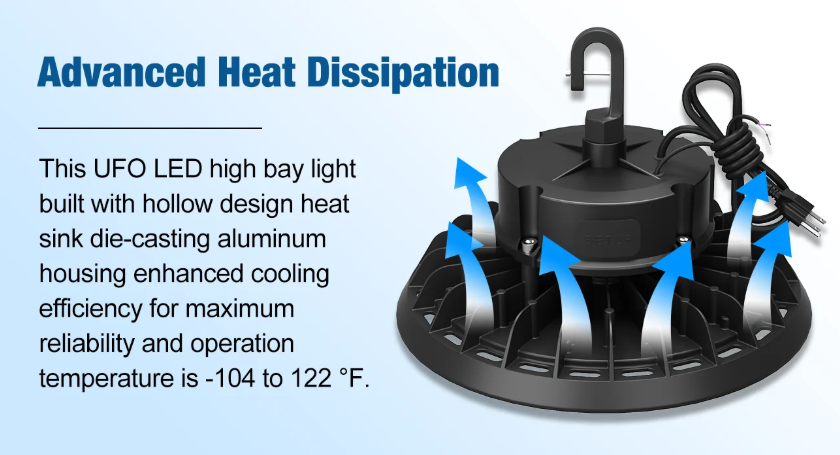
1. Longer Lifespan:LEDs operate in a safer, cooler environment, slowing down lumen depreciation.
2. Consistent Brightness:Maintains high light output (lumens) throughout its life.
3. Maximum Reliability:Reduced thermal stress on drivers and electronic components minimizes failure points.
Application in UFO vs. Linear High Bay Lights
This advanced housing technology is applied to both main types of high bay fixtures:
1. UFO High Bay Lights:The classic circular design is perfectly suited for ahollow design die-casting aluminum housing. The compact, integrated form factor allows heat to be dissipated radially and uniformly from the center. A prime example is an UFO LED high bay light built with hollow design heat sink die-casting aluminum housing. This construction is why such models can reliably operate in wide temperature ranges.
2. Linear High Bay Lights:For linear models, the die-cast housing often takes the form of an elongated, robust spine with extensive cooling fins running along its length. Thehollow designprinciples are applied to create internal thermal channels that draw heat away from the long row of LEDs, ensuring even cooling across the entire fixture.
Why Operation Temperature Range Matters: -104°F to 122°F
The superiority of this design is quantifiable. Consider the specifiedoperation temperaturerange of-104°F to 122°F(-75°C to +50°C). This extreme range is a direct benefit of the efficient thermal management provided by the die-cast housing.
1. Cold Environment Performance:The robustdie-casting aluminum housingprotects internal components from physical stress and condensation in freezing conditions, while the LEDs start and operate efficiently.
2. Hot Environment Performance:In high-ambient-temperature settings like foundries or warehouses with poor ventilation, theenhanced cooling efficiencyof thehollow heat sinkprevents the fixture from overheating, ensuring it continues to operate atmaximum reliability.